Building an Efficient SMT Production Line: A Strategic Guide to Core Decisions and ROI
Building an efficient SMT (Surface Mount Technology) production line goes far beyond purchasing a few machines. It is a systematic engineering project involving product planning, equipment selection, layout design, quality control, and return on investment (ROI). Success requires making critical, interconnected decisions from day one.
Decision 1: Define Product Requirements & Capacity Planning — The Starting Point of All Configurations
This serves as the foundation for all subsequent decisions, establishing the “identity” of the production line. Before planning, answer two fundamental questions:
What to produce? Product variety, complexity, and component types (e.g., density of BGA, QFN, and other fine-pitch components).
How much to produce? Projected annual volume, and whether operations focus on high-volume, standardized production or high-mix, low-volume (HMLV) orders.
Operational Impact:
High-Volume, Low-Mix: Prioritize high-speed, high-efficiency machinery to configure dedicated mass-production lines.
Low-Volume, High-Mix: The core challenge centers on “changeover cost” and “delivery speed.” Flexibility is paramount, requiring quick changeover capabilities and versatile equipment. The essence of a flexible line is not peak placement speed, but rapid response time and changeover efficiency.
Decision 2: Core Equipment Selection & Pairing — Breathing Life into the Production Line
Equipment serves as the heart of the production line; selection directly dictates capacity and quality. A standard SMT line typically incorporates these core systems:
Solder Paste Printer: The “gateway” to SMT quality, as over $60\%$ of soldering defects originate here. Full-automatic printers are recommended to guarantee precision and stability.
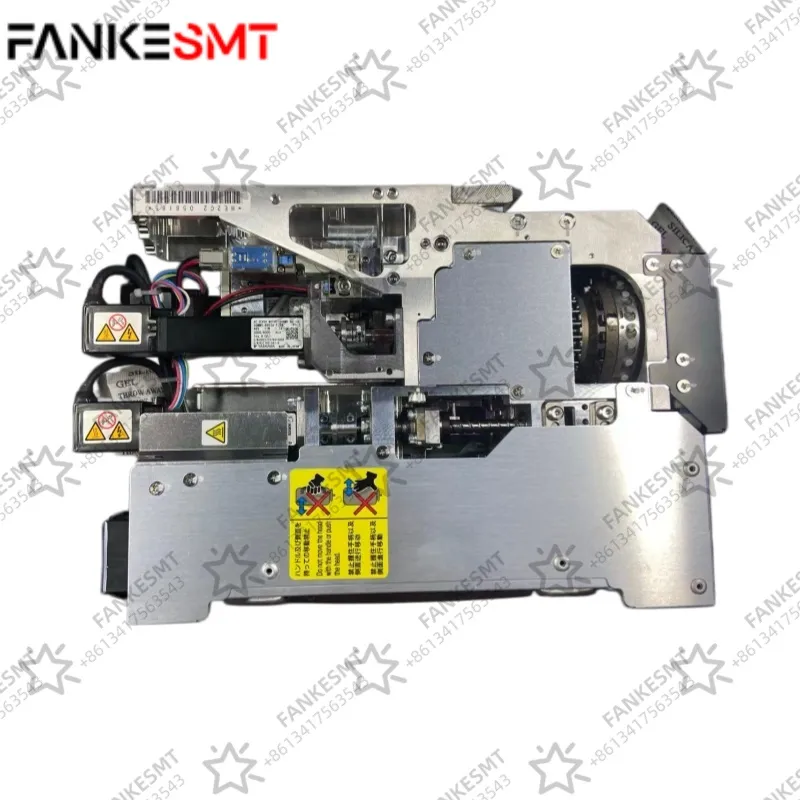
Pick-and-Place Machine: The core and “heart” of the line. Selection is critical:
High-Volume Production: Deploy high-speed placement machines optimized for maximum throughput.
High-Mix, Low-Volume Production: Utilize mid-speed, high-precision placers prioritizing versatility over sheer speed (e.g., JUKI RS-1, Samsung SM482 Plus).
Complex / Odd-Form Components: Integrate multifunctional placement heads to ensure accurate placement.
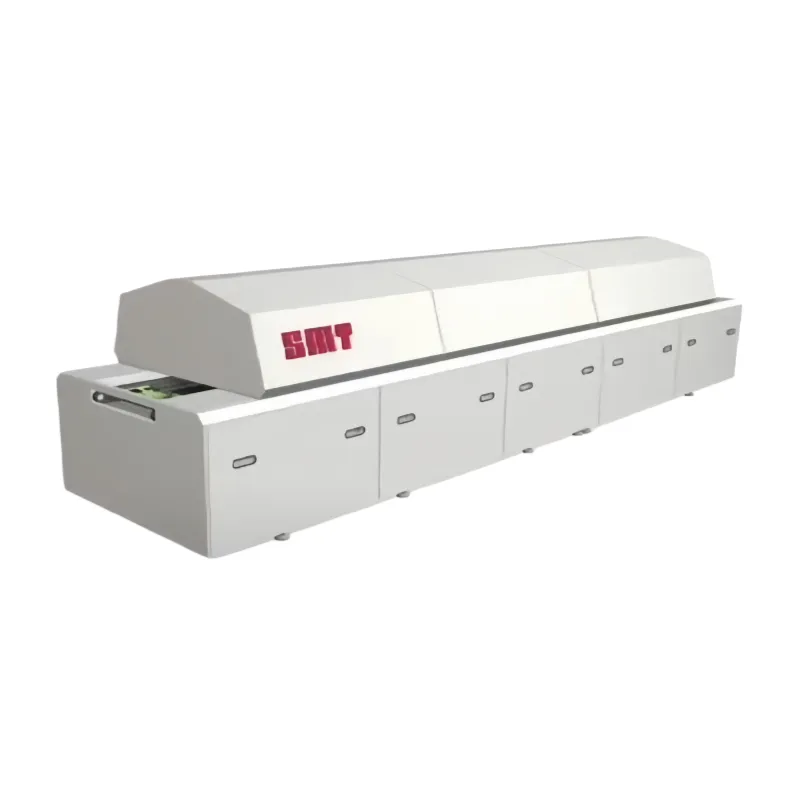
Reflow Oven: Ensures soldering joint stability. Systems featuring $8$ to $10$ heating zones with robust thermal stability are standard.
Inspection Equipment: The quality “gatekeeper.” AOI (Automated Optical Inspection) is mandatory; X-ray inspection is strictly required for hidden-lead packages like BGAs.
Operational Impact:
Equipment investment requires balance. While advanced systems carry high upfront costs, long-term returns manifest through increased throughput, lower defect rates, and reduced downtime.
Decision 3: Production Line Layout Design — Maximizing Space and Process Flow Efficiency
Optimized layouts dramatically reduce material handling and streamline process flow.
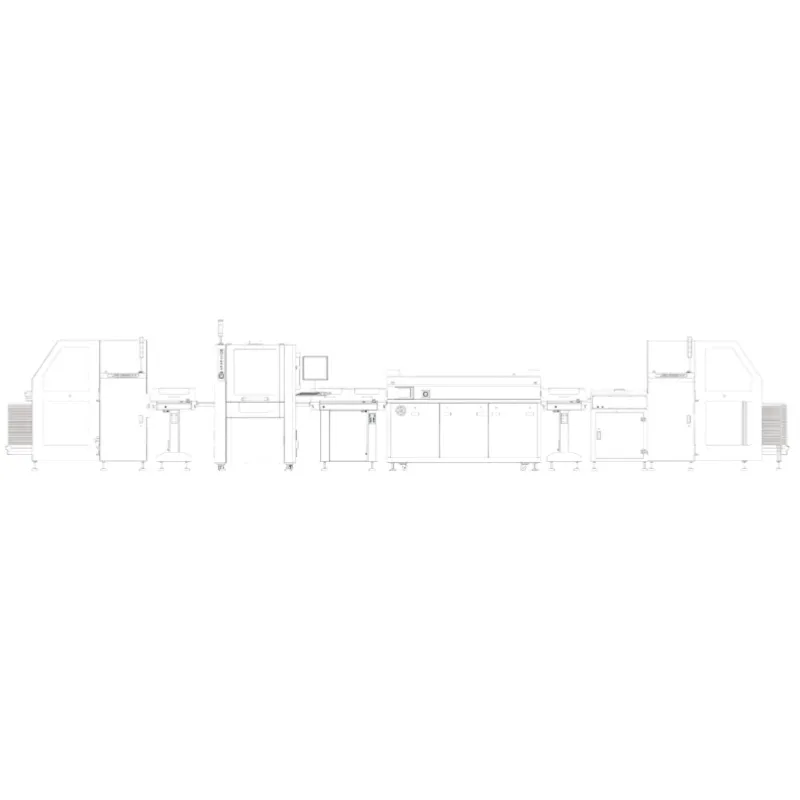
Layout Principles: Adhere strictly to the core SMT process sequence (Loader $\rightarrow$ Printer $\rightarrow$ Placement $\rightarrow$ Reflow $\rightarrow$ Inspection $\rightarrow$ Unloader), utilizing “Linear” or “U-shaped” configurations.
Spatial Specifications:
Reserve $1.2\text{ to } 1.5\,\text{meters}$ of operating clearance between machines.
Maintain a $5\text{ to } 8\,\text{meter}$ buffer zone between placement machines and reflow ovens to prevent thermal or mechanical interference.
Ensure equipment installation leveling is controlled within $\le 0.1\,\text{mm/m}$.
Line Architecture Decisions:
Single-Lane (Single-Rail): Setup and operational costs run $30\%$ to $50\%$ lower than dual-lane configurations, making them ideal for small-to-medium batch production.
Dual-Lane (Dual-Rail): Daily output increases by $60\%$ to $120\%$, suiting high-volume manufacturing, though requiring greater initial capital expenditure and floor space.
Decision 4: Quality Control System Construction — Making Yield Predictable and Controllable
An efficient production line must operate both rapidly and stably.
Process Control:
SPI (Solder Paste Inspection): Intercepts printing defects prior to placement to form a closed-loop control system.
AOI (Automated Optical Inspection): Conducts pre- and post-reflow inspections to rapidly isolate visual defects.
X-ray Inspection: Delivers non-destructive subsurface verification for hidden solder joints like BGAs.
Data-Driven Manufacturing: Implement SPC (Statistical Process Control) to monitor critical parameters in real time. Link inspection data from AOI and X-ray systems to production platforms to establish a closed-loop “defect-material-process” corrective workflow.
Process Windows: Design processes with sufficiently wide technical margins to prevent mass defects caused by minor operational fluctuations during volume production.
Decision 5: ROI and Long-Term Planning — Balancing Financial Ledger and Future Vision
Configuring a production line represents a major capital expenditure requiring clear financial returns analysis.
Cost Structure: Equipment purchase typically accounts for only $30\%$ to $50\%$ of Total Cost of Ownership (TCO), with the remainder driven by hidden operating, maintenance, and energy expenses.
Payback Period: SMT line payback periods generally average around $3$ years (or approximately $4.44$ years post-tax for projects totaling around $11.78\text{ million CNY}$).
Scalability: Plan for future business expansion by reserving spatial footprints and interface provisions to ensure the line adapts flexibly to shifting manufacturing scales.
Conclusion
Configuring an efficient SMT production line fundamentally revolves around striking the optimal balance among speed, precision, flexibility, and cost. These five decisions are deeply interconnected:
Defining requirements (what and how much to produce) anchors all decisions.
Equipment selection dictates core capabilities.
Line layout governs operational efficiency.
Quality systems form the bedrock of yield assurance.
Investment planning ensures long-term sustainability.
For most high-mix, low-volume manufacturing environments, configuring a flexible SMT line anchored by mid-speed, high-precision placement machines, paired with full-automatic printers and stable reflow systems, offers a pragmatic, cost-effective path to rapid market responsiveness.