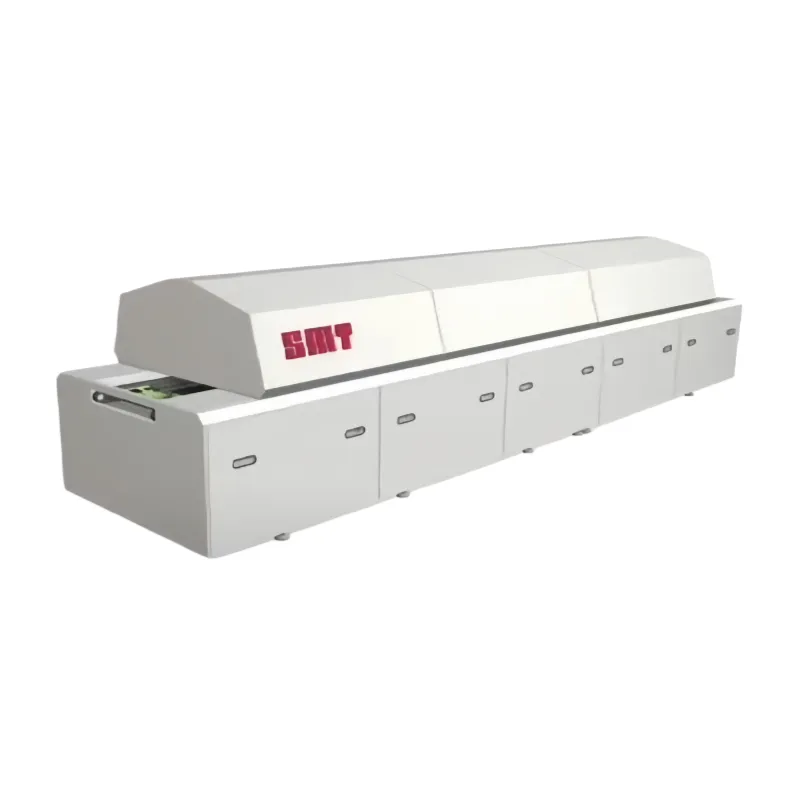
Types and Selection Guide for SMT Solder Paste Printers
In SMT assembly, the solder paste printer is the critical first process. Industry data shows that the majority of SMT defects originate here. Choosing the right printer is essential for ensuring product quality and improving line efficiency. This article provides a comprehensive overview of the main types of solder paste printers and key factors for equipment selection.
1. Main Types of Solder Paste Printers
Classified by the level of automation, solder paste printers are generally divided into three categories: manual, semi-automatic, and fully automatic.
1. Manual Printers
Manual printers are the most basic and economical equipment. All parameters and actions—including PCB loading and unloading, stencil alignment, paste application, and squeegee movement—are performed manually.
Advantages: Extremely low equipment cost and high flexibility, making them suitable for small-scale production, laboratory environments, or simple rework tasks.
Limitations: Print quality heavily depends on the operator’s skill and focus. They offer low precision, poor paste release, and cannot meet the requirements of fine-pitch components.
Current Status: Largely phased out in major industrial manufacturing, manual printers are now mainly used in low-cost labor regions or for initial R&D prototyping.
2. Semi-Automatic Printers
Semi-automatic printers bridge the gap between manual and fully automatic systems. Operations like PCB loading/unloading and stencil alignment are still performed manually, but the squeegee printing stroke is automated and controlled by machine parameters.
Advantages:
High Flexibility: Quickly adapts to different PCB sizes and shapes without complex adjustments, drastically reducing setup time.
Cost-Effectiveness: Lower initial investment compared to fully automatic systems (typically one-third to one-fifth of the price).
Performance & Application: With a throughput of 100 to 200 boards per hour, they suit small-batch, high-mix production. Experienced operators using microscopes and fine-adjustment devices can achieve $\pm 0.05\text{ mm}$ accuracy, satisfying most standard electronics. They are ideal for components above 0603 imperial size with lead pitches greater than $1.27\text{ mm}$, as well as trial runs and R&D prototyping.
3. Fully Automatic Printers
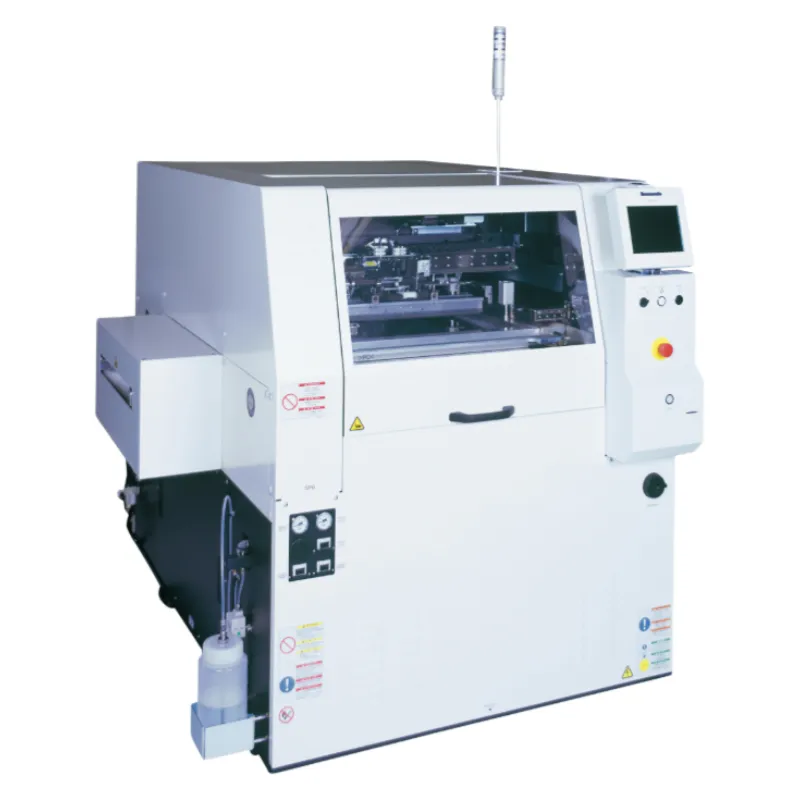
Fully automatic printers represent the current mainstream configuration for SMT lines. They automate the entire process from board entry, vision alignment, printing, and stencil cleaning to board exit, requiring virtually no manual intervention.
4. High-Speed and Modular Printing Platforms
Beyond the main categories, high-speed printers optimize throughput for ultra-large volume production, while modular printing platforms support SPI integration and data traceability for smart factories.
2. How to Select the Right Printer
Selecting a solder paste printer requires a comprehensive evaluation of product precision requirements, production scale, budget constraints, and long-term development plans.
Step 1: Evaluate Product Precision Requirements
Precision is the primary criterion.
Standard passive components with wide pitches ($>1.27\text{ mm}$) only require semi-automatic printers.
High-density PCBs, fine-pitch BGAs, QFN packages, or ultra-miniature components ($<01005$) demand fully automatic printers. High-end precision manufacturing requires high stability and advanced intelligent functions.
Benchmark: High-density PCB printing requires precision within $\pm 25\text{ }\mu\text{m}$, with repeatability preferably better than $\pm 12.5\text{ }\mu\text{m}$.
Step 2: Determine Throughput and Batch Scale
Large-scale manufacturing ($>500,000$ dots/month): Fully automatic printers are ideal.
Small-to-medium enterprises ($100,000$ to $500,000$ dots/month): Semi-automatic equipment offers better value due to lower investment and high flexibility.
Intermediate volume: Consider a hybrid configuration (fully automatic lines for main products, semi-automatic units for prototyping and small batches).
Step 3: Balance Investment and Operating Costs
Initial Budget: Semi-automatic printers cost roughly one-third to one-fifth of automatic systems. Budgets between $30,000$ and $100,000$ RMB often favor semi-automatic units to minimize rework costs from printing defects.
Long-term Value: Fully automatic equipment saves on labor (replacing 2–3 operators per machine) and significantly reduces quality costs through higher first-pass yields.
Step 4: Focus on Critical Performance Parameters
Beyond basic specs, pay close attention to technical parameters that are easily overlooked:
Squeegee Pressure Control Accuracy: Closed-loop feedback systems use sensors to dynamically compensate for stencil unevenness or squeegee wear, ensuring uniform paste thickness across the board.
Stencil Cleaning System: Evaluate dry, vacuum, and wet cleaning mechanisms, focusing on solvent spray uniformity and vacuum suction power.
Rail Clamping and Support Rigidity: High-rigidity designs feature dual-drive synchronization and multi-zone vacuum or pin support to prevent board warping during heavy or large PCB printing.
Software Data Interfaces: Ensure support for standard SECS/GEM protocols or open APIs to integrate with MES systems for SPC tracking and quality traceability.
3. Summary and Recommendations
High-Volume, High-Precision (Automotive electronics, communications, smartphones): Fully automatic printers are necessary to guarantee efficiency, precision, and stability.
Low-Volume, High-Mix (R&D prototyping, pilot runs, small-batch processing): Semi-automatic printers offer an economical solution with quick changeovers.
Extremely Limited Budget / Low Precision: Manual printers serve as a transition option, keeping in mind their inherent quality instability.
Final Pro Tips:
Conduct trial print validations using actual products to verify performance.
Run continuous production tests for at least 72 hours, monitoring CPK fluctuation and OEE data.
Establish strict acceptance criteria, covering print precision, solder paste thickness inspection, and SPC statistical analysis.