Essential SMT Components: A Guide to the Electronic Parts You Need to Know
Behind the dense codes on an SMT (Surface Mount Technology) BOM (Bill of Materials)—such as R, C, L, and U—lie the various components that form the physical reality of electronic products. Although diverse in types, they can generally be categorized into three major groups: passive components, active devices, and electromechanical/other devices.
Passive Components: The “Building Blocks” of Circuits
These components do not generate electrical energy themselves; their primary function is to regulate and control electrical signals. They are the most numerous components on a PCB.
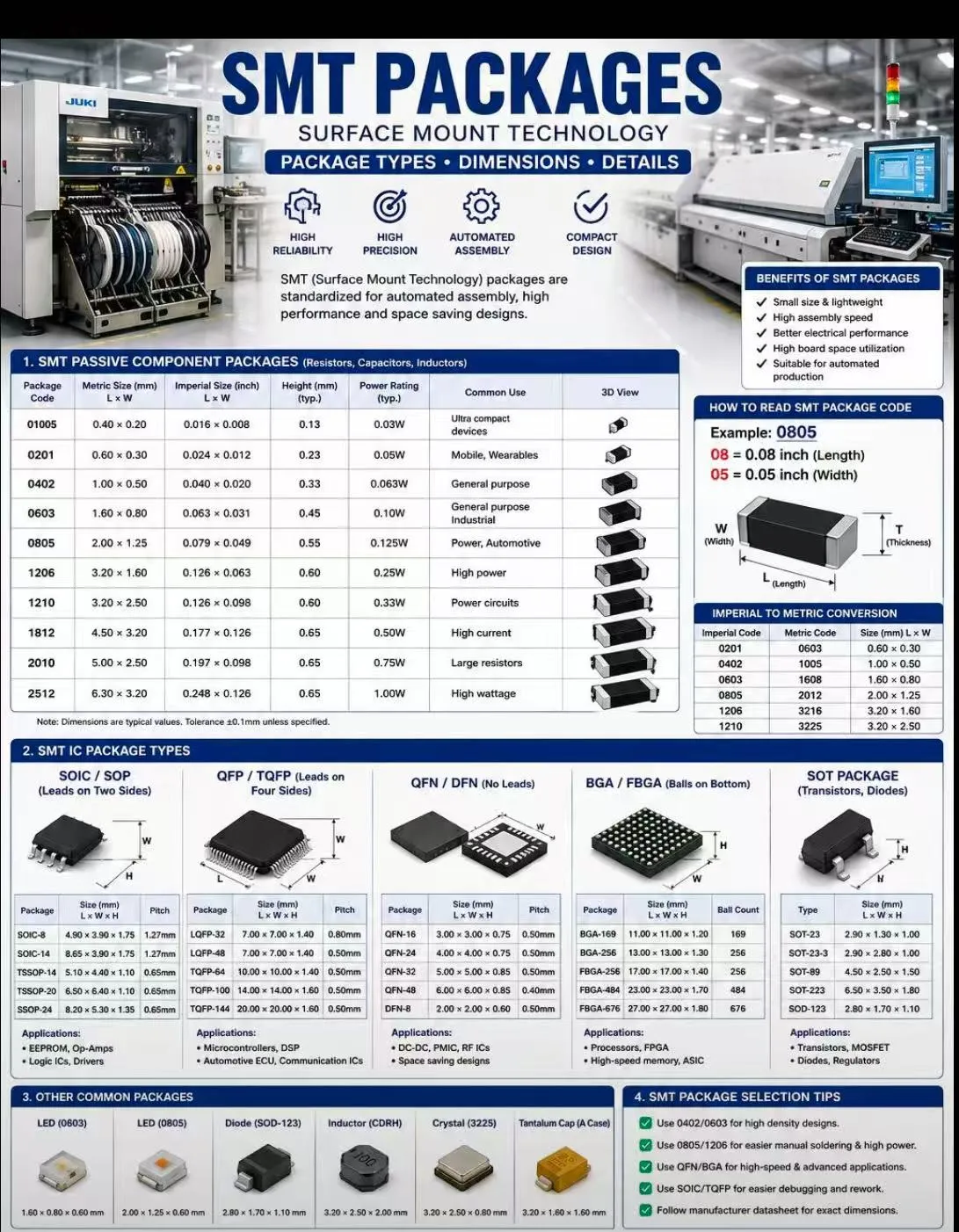
Resistors (R): Used for current limiting, voltage division, and more. Common surface-mount resistors include thick film (cost-effective) and thin film (high precision). Package sizes like 0402 and 0603 represent their physical dimensions.
Capacitors (C): Used for filtering, coupling, and energy storage. Common types include ceramic capacitors (excellent high-frequency performance), tantalum capacitors (high capacitance and stability), and aluminum electrolytic capacitors (high capacitance, used in power supplies).
Inductors (L): Used for filtering, choking, and energy storage. Main types include multi-layer ceramic inductors (compact size) and wire-wound inductors (higher inductance values).
Ferrite Beads (FB/L): Specially designed to suppress high-frequency noise and electromagnetic interference (EMI), serving as key components to enhance circuit anti-interference capabilities.
Active Devices: The “Brains” of Circuits
These devices require an external power source to operate and can amplify, convert, or otherwise process electrical signals.
Diodes (D): Characterized by unidirectional conductivity, used for rectification, voltage regulation, and more. Common types include Schottky diodes (high-speed switching) and Zener diodes.
Transistors (Q): Used for signal amplification and switching control. Common packages include SOT-23.
Integrated Circuits (U/IC): Integrate a large number of transistors onto a single chip to perform complex functions. Their packaging forms dictate the difficulty of soldering and inspection:
SOP/SOIC: Leads extend from two sides, making them relatively easy to solder.
QFP: Leads extend from all four sides, suitable for chips with a high pin count.
BGA: Solder balls are located underneath the chip, presenting high soldering difficulty and requiring X-ray inspection.
Optoelectronic Devices: Enable photoelectric conversion. The most common is the SMD LED (Light Emitting Diode), alongside optocouplers used for signal transmission.
Electromechanical & Other Devices: The “Interfaces” and “Heart” of Circuits
Connectors, Crystals, and Switches: Connectors bridge board-to-board or external connections; crystal oscillators provide stable clock signals for the circuit; transformers handle voltage transformation and isolation.
Conclusion
While SMT components vary widely in types, they all fall into three major categories: passive components, active devices, and electromechanical/other devices. Understanding this classification not only helps in reading BOM lists, but also deepens our grasp of how different components (especially ICs like BGAs and QFP) impose unique requirements on production processes and quality inspections (such as X-ray testing), representing essential knowledge from design to manufacturing.