Complete Guide to SMT Production Line Peripheral Equipment: Types, Functions, and Selection
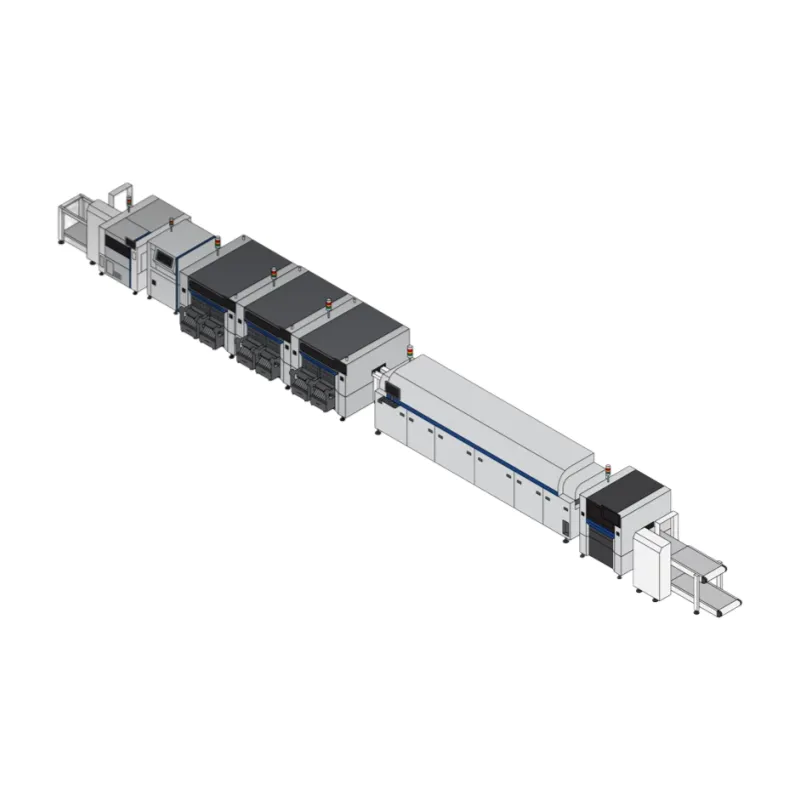
For an SMT (Surface Mount Technology) placement machine to operate efficiently and stably, it relies on the seamless coordination of a comprehensive suite of peripheral equipment. Serving as the “right hand” of the placement machine, these peripherals are categorized into material handling, transport and buffering, quality inspection, and process support, each playing a vital role in the production ecosystem.
1. Board Handling and Material Transport Equipment
These devices manage the automated feeding, transfer, and collection of PCBs, forming the foundation of line automation.
Loader: Positioned at the front of the production line, it automatically and smoothly feeds blank PCBs one by one into the printer using magazine lifts or vacuum suction, saving labor and preventing manual handling damage.
Unloader: Located at the end of the line, it automatically collects soldered PCBs from the reflow oven exit into magazines.
NG/OK Sorting Conveyor: An upgraded unloader that automatically sorts qualified (OK) and defective (NG) boards into separate magazines based on signals from inspection equipment like AOI.
Stacker: Uses a vacuum suction system to lift and transfer stacked bare boards layer by layer, often paired with loaders or used for specialized applications.
Dual-Function Loader (Suction & Push): Integrates both push and vacuum suction loading modes, offering high flexibility for different board types.
2. Transport, Conveyor, and Buffering Equipment
Acting as bridges and buffers, these systems ensure smooth, uninterrupted PCB transfer across the line.
Conveyor: The most common connection equipment linking printers, placement machines, and reflow ovens for smooth PCB transition. It also serves as a temporary buffer or workstation for manual inspection/insertion.
Buffer Machine: Temporarily stores PCBs to balance cycle time discrepancies between upstream and downstream equipment (e.g., when a placement machine runs faster than the reflow oven), preventing board congestion and damage.
Smart Buffer / NG Buffer Conveyor: Positioned after SPI or AOI systems, it routes defective (NG) boards to an upper buffer tier for manual intervention while passing good boards straight through to avoid line stoppages.
Flip Board (Turnover Machine): Automatically flips PCBs 180° for double-sided surface mount processing.
Parallel / Corner Transfer Conveyor: Connects equipment with different rail configurations (e.g., linking a single-lane placement machine to a dual-lane reflow oven) or facilitates 90-degree turns in layout-constrained workshops.
3. Quality Inspection and Monitoring Equipment
Acting as the “eyes” and quality controllers of the line, these systems monitor product quality at every stage.
SPI (Solder Paste Inspection): Installed after the solder paste printer to inspect paste volume, thickness, area, and shape, detecting printing defects prior to placement.
AOI (Automated Optical Inspection): The core vision inspection system in SMT lines.
Pre-reflow AOI: Checks placement accuracy (offsets, missing parts, polarity).
Post-reflow AOI: Checks soldering quality (cold joints, bridging, insufficient solder).
X-Ray Inspection System: An advanced non-destructive inspection tool used to evaluate hidden solder joints under BGAs, QFNs, and multi-layer packages, detecting voids and bridging invisible to optical systems.
4. Process Support and Special Treatment Equipment
These devices support specific manufacturing processes or handle pre- and post-assembly tasks.
Solder Paste Mixer: Stirs refrigerated solder paste via orbital and rotational motion to achieve uniform consistency and eliminate bubbles before printing.
Dispenser: Precisely applies adhesives or solder paste onto specific PCB locations, such as dispensing red glue prior to placement or underfill for BGA chip reinforcement.
De-panelizer (PCB Separator): Cuts multi-unit panel PCBs along V-cuts or stamp holes after reflow soldering. Compared to manual breaking, it offers high precision and low mechanical stress to protect components and solder joints.
Conformal Coating Machine: Automatically sprays a protective coating layer onto PCBA surfaces after electrical testing to provide moisture, dust, and chemical resistance.
Rework Station: Used to repair defective PCBAs, such as BGA rework stations that safely remove and replace large or fine-pitch ICs using precise thermal and placement control.
5. Other Auxiliary Equipment
Laser Marker: Automatically etches data matrix codes, barcodes, or text onto PCBs for full traceability.
Splicing / Counting / Reeling Machines: Material management tools for splicing tape reels, accurately counting component quantities, or splitting large reels into smaller batches.
Insertion Machine: Automatically inserts DIP (Dual In-line Package) through-hole components into PCB holes (typically omitted if the line lacks a wave soldering process).
Conclusion
Together with placement machines, printers, and reflow ovens, these peripheral devices form an integrated, high-performance SMT production line. While individual peripherals may operate behind the scenes, they are critical to achieving high efficiency, stability, and product yield.
Note: SMT line configurations vary dynamically based on product types, manufacturing scale, budget constraints, and target automation levels.